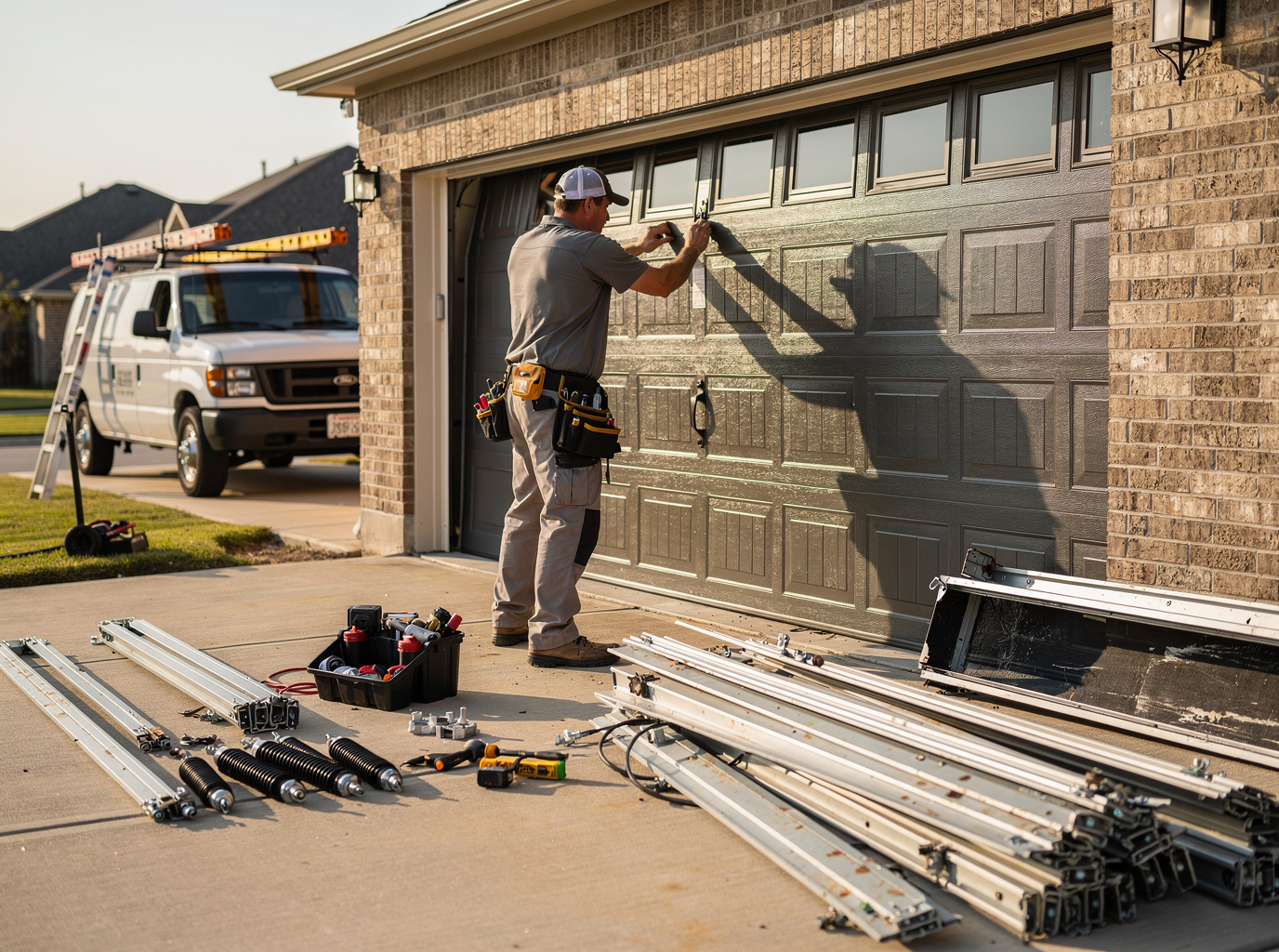
Garage Door Repair Allen works on residential garage doors across Allen, from the older subdivisions near Ridgeview Drive to newer builds off Watters Creek Road. A door that sticks halfway up, rattles through its track, or refuses to close is rarely a random failure. We start by finding out what actually wore out, then explain it in writing before any work begins, so you know exactly what you are agreeing to.
Why Garage Door Repair Allen
We operate from 1026 S Greenville Ave in Allen, so our day starts on the same roads our customers drive every morning, including Stacy Road, Exchange Parkway, and the stretch of Central Expressway that backs up near the Watters Creek shopping area. That local footprint shapes how we work. We see the same door styles repeatedly in Allen neighborhoods, from builder-grade steel sectional doors to insulated models installed during the subdivision growth of the late 1990s and 2000s, and we know which parts tend to fail on each.
Our first step on every call is an inspection, not a parts list. We look at torsion springs, cables, drums, rollers, hinges, end brackets, and track alignment, and we check how the opener handles the door's weight and travel. Nothing is replaced just because it is old. If a part still has service life, we say so and explain why.
Every finding is written down before any work starts. You will see what we inspected, what we measured, which components need attention, and which ones can wait. You decide what happens next, and nothing moves forward until you have read the notes and asked whatever questions you have.
We also show you the difference between the failed part and its replacement. Holding the old roller next to the new one, or setting a cracked panel beside its replacement, makes the repair easy to understand. Our work can be checked by anyone who looks at it: square tracks, balanced doors, clean cable routing, and a door that stops where it should.
We keep our communication plain. If a repair is not worth doing on a particular door, we will tell you that directly, because a repaired door should last, not come back in a month.
Why Now Is a Good Time to Look at Your Door
Allen summers push garage doors hard. Once afternoon temperatures stay above the upper 90s and into triple digits for weeks at a time, metal expands, lubricant thins, and the weatherstrip on the bottom panel hardens and cracks. Torsion springs, which carry most of a residential door's weight, are under constant stress through those months. A spring that has been working near its limit for a decade can give out during a July heat wave, usually at the worst possible time, such as when you need to leave for the airport in the early morning.
Spring and early summer bring a different set of problems. North Texas hailstorms can dent steel panels and crack older insulated sections, and a door damaged in one storm may still close but fail to seal, letting in dust, pests, and rain. Catching that early keeps a single damaged panel from stressing the rest of the door.
The ground under Allen adds another factor. Much of the area sits on expansive clay that swells after wet weeks and shrinks during dry stretches. Over time, this movement can shift the garage slab and throw a track out of plumb. A door that was level last year may bind on one side this year, and that binding pushes extra load onto rollers, hinges, and the opener.
Winter brings its own complications. Cold snaps stiffen springs and cables, and a door that struggles in January is often telling you that its lubrication has dried out or its springs are nearing the end of their life. Addressing these issues before the hottest and coldest parts of the year is far easier than handling an emergency.
If your door has been making new noises, sitting unevenly, or closing more slowly than it used to, now is a good time to look. A short inspection can show what is changing and whether it needs attention before it becomes a bigger job.
How We Work Through Each Repair
Every job follows the same sequence, so you always know where things stand. The process starts with a visual and functional inspection of the entire door system. We check the springs for gap and wear, examine the cables for fraying and proper seating on the drums, look at rollers and hinges for play or cracking, and confirm that the tracks are level, plumb, and secure to the framing. We also run the door through several cycles by hand and with the opener to see how it behaves under load.
Next comes the written findings stage. Before we touch anything that matters, we list what we found, what is failing, what is wearing, and what is still fine. Each item includes a short explanation in plain language. If a repair involves a spring or cable, we describe the safety considerations and what the work will involve.
Once you have reviewed the findings and decided how to proceed, we walk through the old and new parts together. This is where you see the failed component beside its replacement, compare the wear pattern to the new surface, and ask any questions about how the part works. That conversation is the point where you understand the repair, not just accept it.
The repair itself is done in a controlled sequence. Springs are handled with proper tools and attention to tension. Tracks are adjusted and tested before fasteners are fully tightened. After the work, we run the door through full open and close cycles, test the opener's safety reversal, and check the door for balance. We clean up the work area and remove old parts from your property unless you ask us to keep them.
A Typical Allen Garage Door Scenario
A two-car garage in the Twin Creeks area shows a pattern we see often in Allen. The homeowner noticed one bottom-section panel had been struck during a spring hailstorm, with a visible dent and a crack running across the lower third of the panel. The rest of the door still moved, but the damaged section had started to rub against the weatherstrip, and the homeowner wanted to know whether the whole door needed to be replaced.
During the inspection, we checked the springs, cables, rollers, and track alignment before deciding anything. The springs were within their expected range, the cables were seated correctly, and the track was level and secure. The only real problem was the cracked panel, which had lost its structural integrity along the joint where it connects to the next section. That meant the job could focus on one panel rather than the whole door.
We wrote up the findings with the crack location, the panel dimensions, and the reason the rest of the door could stay in place. Then we walked the homeowner through the replacement panel next to the damaged one, showing how the edge profile and hinge alignment would match. Once they approved the plan, we replaced the panel, reconnected the hinges, and checked that the section sat flush with its neighbors.
After the replacement, we ran the door through repeated cycles, confirmed the bottom seal made proper contact with the floor, and tested the opener's safety reversal. The door moved smoothly, the new panel stayed aligned, and the existing hardware carried on working. The homeowner was able to see the old and new parts side by side and understand exactly what had been done.
Common Garage Door Components in Allen Homes
Most residential garage door problems in Allen trace back to a small group of components. Knowing how they work helps you describe what you are noticing and understand what our inspection will look at.
Torsion Springs and Cables
Torsion springs sit on a steel shaft above the door opening and do most of the lifting work. Cables run from the bottom bracket up to the drums on the shaft and keep the door balanced as it travels. In Allen, springs are often the first component to show fatigue after long summers, because repeated heat cycles weaken the steel over time. Cables fray where they bend around drums, and an unbalanced door puts extra strain on the opener.
- Spring wear often shows as a visible gap between coils or a change in how the door sits when released.
- Frayed cables are a warning sign that should be checked before the door is used again.
- A door that feels heavy or drops suddenly after weather changes may point to spring tension issues.
- Spring work is handled carefully with proper tools, because stored tension can cause serious injury.
Openers, Safety Reversal and Sensors
The opener moves the door, but it depends on the door being balanced and free of binding. In many Allen homes built with older openers, the safety reversal system no longer responds as it should, or the photo-eye sensors near the floor have shifted out of alignment. Sensors can be knocked out of position by a bicycle, a trash can, or a pressure washer.
- Photo-eye sensors need a clear line of sight and matching alignment on both sides of the door.
- Safety reversal should stop and reverse the door when it contacts an object on the floor.
- Opener force settings can drift as springs age, which often shows up as a door that stops early.
- Every opener check includes a reversal test so you know the safety system works before we leave.
Tracks, Rollers and Hinges
Tracks guide the door along its path, while rollers and hinges keep it moving smoothly around the curve. Allen's clay soil can shift a slab over time, which can throw a track out of plumb and cause binding. Worn rollers may be quiet at first, then start grinding or sticking, and hinges can loosen and stress the panels they connect.
- Track alignment should be checked for level, plumb, and secure fastening to the framing.
- Nylon or steel rollers with flat spots or cracks should be replaced rather than tolerated.
- Hinges that have loosened or cracked can cause panels to bind or pull apart over time.
- Track and roller work is tested by cycling the door several times and watching for rubbing or uneven movement.
Next Step and Common Questions
If your garage door is sticking, noisy, uneven, or simply not behaving the way it used to, the next step is an inspection. We will look at the door as a complete system, explain what we find in writing, and walk through any replacement parts with you before work begins. You will never be asked to approve something you have not seen or understood. The inspection is the starting point for everything else.
Some homeowners in Allen wonder whether a damaged door is worth repairing or whether replacement makes more sense. That depends on the age of the door, the condition of the panels, the springs, the tracks, and the opener, and on what the written findings show. We will tell you plainly if a repair is a good use of your money and if it is not.
We also understand that garage doors are used every day, often without much thought until something goes wrong. Our goal is to make the repair process clear, calm, and easy to follow. Describe what you are seeing, let us know which part of the door is giving you trouble, and we will set up an inspection window that fits your schedule. Once we have the findings in writing, you decide the next step.
Structure Note
The sections above cover the core repair process, local conditions, and key components so you can make an informed decision about your garage door.
Technician insight
In Allen, the thing that catches most people out with Garage Door Installation and Replacement is the slab. The clay soil here swells after wet spring weeks and shrinks during August, so a track that was level last year can sit out of plumb now. Before we set a new door, we check the header and track alignment, because a new door on a shifted frame wears out quickly.
Hail-Cracked Panel on a Twin Creeks Two-Car Garage
A homeowner in the Twin Creeks area noticed a dented bottom panel after a spring hailstorm, with a crack running across its lower third. We inspected the springs, cables, rollers, and track, which were all within their expected range, and found the cracked panel was the only real problem. We wrote up the findings, walked the homeowner through a replacement panel beside the damaged one, and replaced just that section. The door now cycles smoothly with the bottom seal sitting flat on the floor, and the existing hardware remains in service.
Garage Door Installation and Replacement Services We Offer
✓Garage Door Panel Replacement
When one or two sections are cracked, dented, or separated from the hinges, replacing only the affected panels is often the most sensible route. We inspect the surrounding panels, springs, and track first to confirm the rest of the door is sound. Then we walk through the old and new panel together, check that the edge profile and hinge alignment match, and test the door after installation.
✓Garage Door Maintenance
Routine maintenance keeps a door balanced, quiet, and sealed through Allen's hot summers and cold snaps. We inspect springs, cables, rollers, hinges, tracks, and the opener's safety system, lubricate moving parts, and tighten hardware. Every finding is written down so you know what was checked and what, if anything, needs attention next.
How it works
- 1
Inspection of the Full Door System
We check springs, cables, drums, rollers, hinges, tracks, and the opener together, since a problem in one part often shows up as stress in another. The inspection includes manual cycles and a look at how the door balances at different heights.
- 2
Written Findings Before Any Work Starts
We write up what we found, what needs attention, and what can wait, using plain language. You read the findings and decide how to proceed before any repair begins.
- 3
Walk-Through of Old and New Parts
We show you the failed component next to its replacement so you can see the wear pattern and understand what changed. This conversation confirms the repair plan and answers questions before work starts.
- 4
Repair, Test Cycles and Cleanup
Repairs are done in a controlled sequence with proper tools. We finish by running the door through full cycles, testing the safety reversal, checking balance, and clearing the work area and removed parts.
Pricing
Written findings arrive before any work starts, so the scope of a repair is visible to you before you decide how to move forward.